




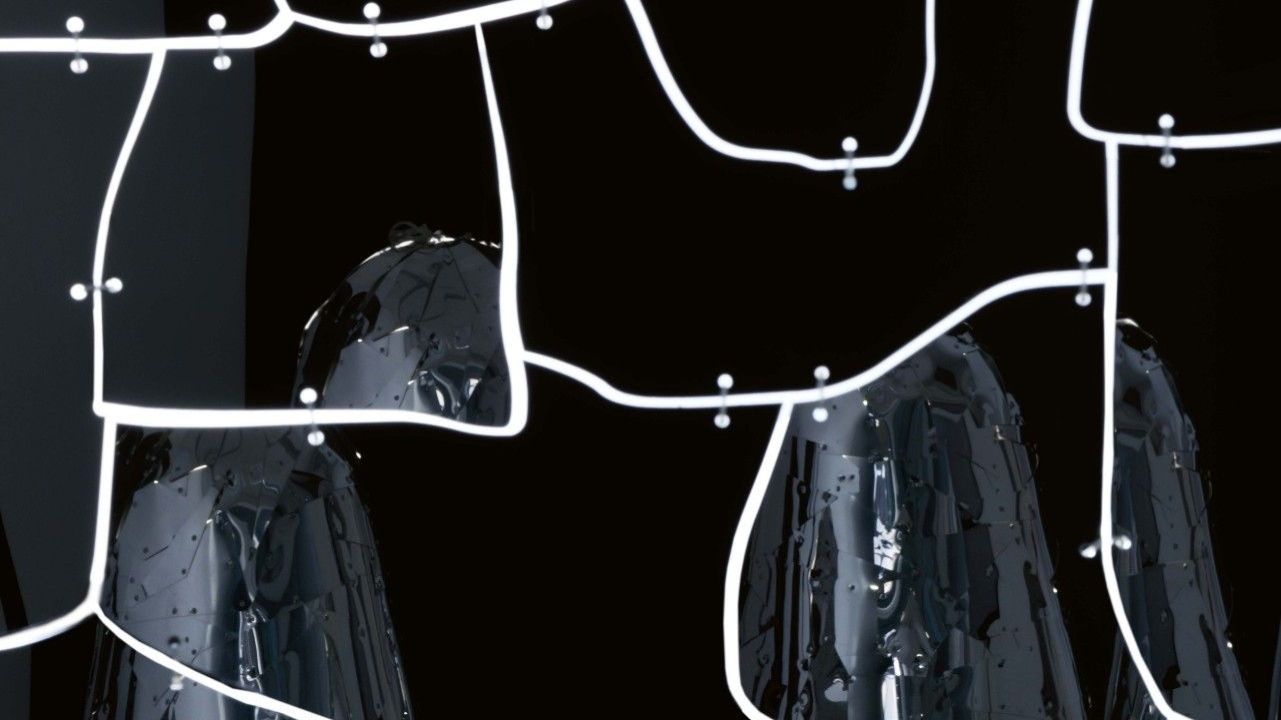
Miraggio. A detail of the mirror reflecting the Campana lamps.
October 2026
Light and the Forms of the Visible
Light in Edra: a language expressed through objects, spaces, images and words
+Light cannot be seen, it is recognized
Light does not coincide with what appears. It is not added to things as an additional attribute, nor can it be reduced to a quality that makes them more or less legible. It already exists beforehand. Or perhaps it occurs as things become visible, in that transition that can never be fully grasped.
One does not truly look at light. One perceives it indirectly, through the way it alters relationships, modifies distances, brings some presences closer while allowing others to slip into the background. This is where it operates, without settling into a fixed form. Not as a stable entity, but as a condition that is continually redefining itself.
In design, this dimension often remains implicit. Light is treated as a technical variable, something to be controlled or optimized. Rarely does it become an object of thought. And yet there is a subtler, less explicit line along which light ceases to be a tool and asserts itself as the foundation of experience.
It is along this line that Edra’s work is situated.
Not because it produces luminous objects. Rather, because it creates objects that are not exhausted by their form. Objects that truly exist only when they enter into a relationship with light. Without that relationship, they remain incomplete, as if a decisive condition were missing.
Each project can therefore be understood as a perceptual device. Not a machine that produces effects, but an unstable field in which light is constantly at work. At times it subtracts, allowing what normally remains invisible to emerge. At others, it thickens, transforming the very consistency of space. In this movement, which is never linear, light ceases to be a medium and begins to behave like a language.
The threshold of the visible
Exploring the Edra collection, it is not the variety of forms that emerges. Rather, it is a deeper, almost subterranean coherence. Matter never remains neutral. It does not merely serve as a support. It always enters into a relationship with light and, in some way, transforms it. One possible example is Jacopo Foggini’s Phantom table: the object appears, but never settles into a fixed presence. It depends on the angle, the distance, the quality of the light. A minimal shift is enough for its presence to change. The table does not occupy space definitively. Rather, it passes through it. Or perhaps it allows itself to be traversed. Under these conditions, light introduces a form of uncertainty. What seems to disappear does not truly vanish, but shifts, redefines itself elsewhere, and assumes a less controllable configuration.
Growth without a center
With the Campana brothers, the theme changes scale. It is no longer concerned only with the surface or with immediate perception. It involves structure.
Form is never given once and for all. It is constructed through accumulation, but without following a linear logic. Each element is added to the others, introducing a variation that prevents the system from closing. In this sense, the metaphor of fractals can be useful, though not in a rigorous sense. More than a model, it is a way of thinking about growth without a stable center.
In works such as Jubilé or Miraggio, the mirror loses its traditional function. It no longer returns a coherent image. It fragments, becomes misaligned, multiplies points of view. The gaze finds no foothold. It is forced to move, to continually reorganize itself.
The world is not confirmed. It is called into question.
In this context, light does not help us see better. Rather, it introduces complexity. But precisely for this reason, it opens up unexpected possibilities. The image does not simply break apart. It expands, disperses, becomes something else.
The mirror is no longer a device for recognition. Instead, it functions as a site of loss. It makes reality unstable rather than stabilizing it. And within this instability, a plurality of visions emerges, none of which can establish itself as definitive.
The same occurs in the Scrigno console and the Brasilia tables. The surface does not present itself as a continuous plane. It is crossed by interruptions and shifts that prevent a unified reading. The eye has no footholds on which to rest. And so it flows, stops, stumbles, starts again.
In the Campana lamp, light has no single origin. It is not distributed evenly. It slips between the parts, gets lost, re-emerges. It does not illuminate the object from the outside. It seems to originate within the very structure of the object.
Light as substance
With Jacopo Foggini, the relationship between matter and light is reversed. Light is no longer something that arrives from outside. It is already within the material.
Polycarbonate retains, reflects and sometimes even seems to delay light, as if it preserved a trace of it.
In the Diamante side tables, what strikes the eye is not so much the form as the depth. Not physical depth, but perceptual depth. The gaze enters and encounters no clear boundary. Light breaks apart, but not in a predictable way. It spreads along trajectories that cannot be completely controlled.
In the Alice armchair, the process becomes even more evident. The object is not illuminated. It emerges from light. The source is incorporated into the structure and alters the perception of the material from within.
In other cases, the material takes on different behaviors. It can become light as embroidery, or compact as crystal. It can rise vertically, evoking natural forms, or spread into surfaces that seem to retain the movement of water.
With the A’mare collection, this quality becomes explicit. The surface does not return a stable image. It vibrates. Light dissolves contours instead of defining them.
The object never remains identical to itself. It changes over time, throughout the day, in relation to the conditions that surround it.
But it is with the Dilly lamp that this research takes on a declarative form. Light is no longer mediated. It becomes the origin. The polycarbonate thread does not support it. It generates it. The material becomes so light that it becomes emission itself.
The memory of light
An essential part of Edra’s research into light concerns materials, understood not as simple coverings but as sensitive devices.
Each material reacts to light differently. Some reflect it sharply, others diffuse it, while still others retain light and return it slowly. In this sense, matter functions as a memory. It records and reworks what it receives.
Light is not external to the object. It is already inscribed in its composition. The surfaces of sofas and armchairs, from this perspective, vibrate, react and change in depth. They never remain still. Nor is color uniform. Rather, it layers itself, changes and depends on conditions.
This material seems to come from elsewhere. It may recall the shimmer of precious stones, the coldness of glaciers, the density of moss or the depth of water. These are not decorative evocations. It is a matter of optics.
Collections such as Minerals, Gems, Glossy Matt or Every Stone do not simply create a color palette. They stage different ways of reacting to light. The surface becomes an unstable field, constantly poised between absorption and reflection.
Dramas of the visible
In installations, this logic extends to encompass space itself.
Darkness is not absence. It is an active condition. It allows light to select, isolate and construct sequences.
Objects do not emerge through arrangement. They emerge through intensity. Some become protagonists, while others remain suspended.
Mirrors multiply, surfaces amplify, and moving images introduce a narrative dimension.
Space is constructed like a score. A dark frame receives each appearance and measures it. Reflective surfaces expand the environment. LED walls introduce landscapes that overlap with the objects and transform them. The gaze moves without a precise constraint, constructing a vision that always remains open. In this context, the installation is not simply an exhibition, but the construction of scenes and sequences.
Writing with light
For Edra, photography is not a neutral device for representation. It is part of the project. It is the place where light becomes an explicit language.
The choice to collaborate with artists such as Giovanni Gastel and Aurelio Amendola is not accidental: both work with light not as a descriptive tool, but as a material capable of constructing the image.
For Gastel, light is a material of transformation. “According to Scripture, when we rise again we will be luminous and perfected. So, I want to compete with God.” This is not a provocation, but an aspiration. Light becomes a tool for elevating and perfecting the image. Each subject is not simply illuminated, but brought toward a more intense, more complete form of presence. As if the photographer wanted to capture its soul and essence. At the same time, Gastel’s light is calibrated, never generic: “not everyone looks good under the same light; it has to be adapted to the person who must emanate it as well as receive it.” Light cannot be applied mechanically; it must be measured and attuned.
Amendola’s approach to photography is different. Here, light does not perfect, but reveals. And it always does so in relation to shadow. “Light bursts forth with all its force, revealing beauty […] in opposition to shadow, which, with equal strength, conceals it.” It is a light that does not reconcile, but exposes; that highlights precisely because something remains hidden.
In both cases, chiaroscuro is not an aesthetic effect, but a tool for understanding.
The object emerges from the shadow not as a function, but as an apparition. A sofa becomes mass, tension, volume. A surface is transformed into a landscape.
In this sense, photography does not document, but interprets. And it makes visible, through different means, the same research that involves and concerns the objects and installations.
It is, quite literally, a writing of light.
Revelation
Light does not occupy space. It adds nothing. And yet, without it, nothing truly exists for the gaze. This is why it represents the most precise metaphor for Edra’s work: a research that moves through objects, materials and spaces and transforms them into conditions of visibility.
Light does not intervene. It is already within things. It is what makes them present. Invisible, and decisive.


