




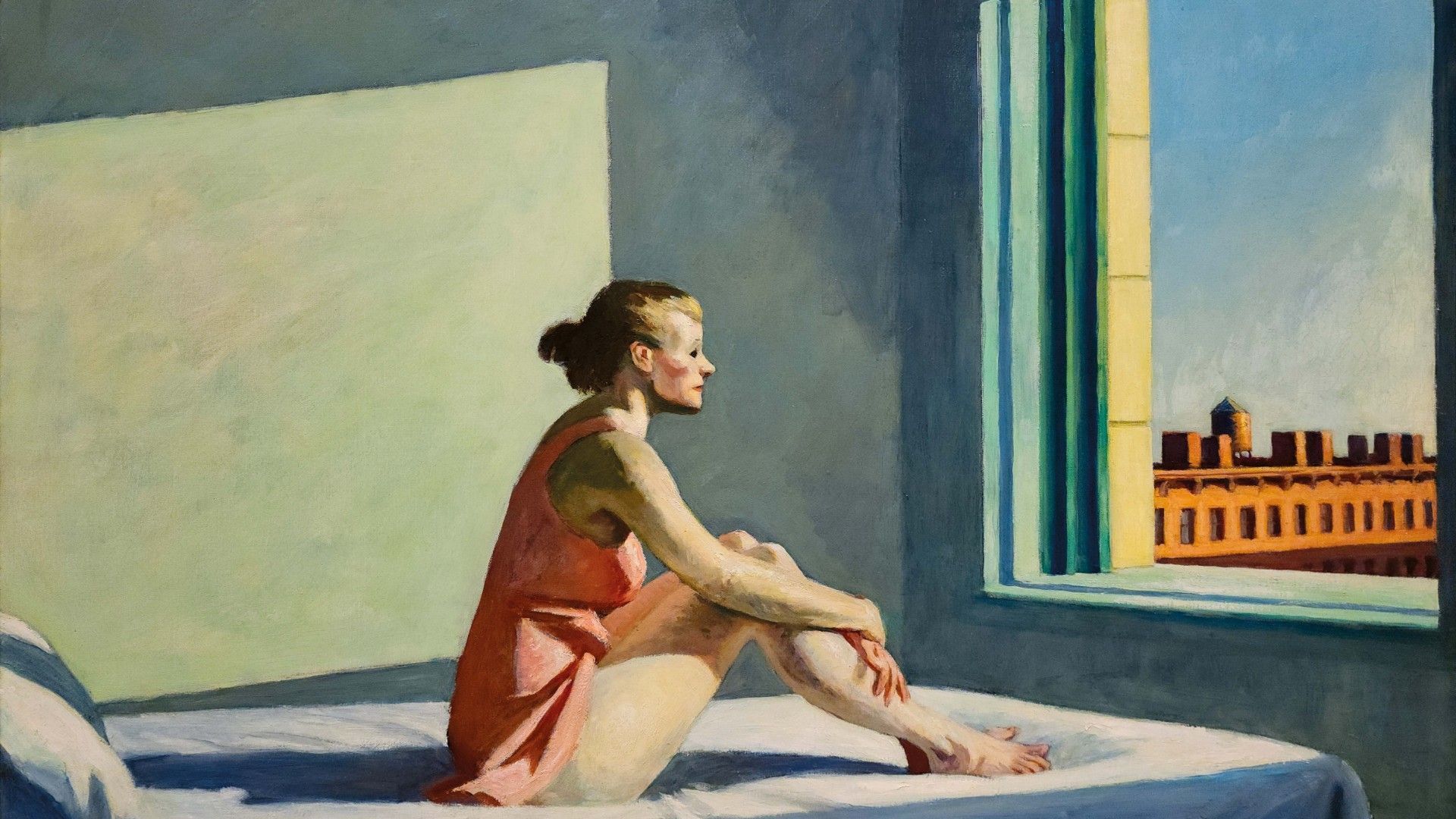
“Morning Sun”.
The 1952 painting by Edward Hopper, held at the Columbus Museum of Art in Columbus, Ohio, United States.
October 2026
Chasing dancing stars
Light makes everything in the world exist and represents it to us, it gives plasticity of form to objects and allows us to perceive the materials they are made of: so accustomed are we to light that these things alone would be enough for us to say, together with Antoine de Saint-Exupéry, that "what is essential is invisible to the eye",
Light is also colour, the colours we attribute to things we see: even though this is only a pretence, a trick of the mind taking place since the dawn of time, please don’t tell us. Don’t reveal it is we who translate the oscillating light waves into reds, yellows, blues and their infinite permutations in our head, that really everything is made of one single sad colour. In this case I propose calling it "nostalgia grey".
We want to carry on seeing the primary colours play together, giving life to spectrums of new shades and imitating the Great Theatre of Nature with its spectacular variations. We are willing to go further and use AI to immerse ourselves in unexplored territory, chasing new luminous qualities that theories of light—from Aristotle to Goethe and from Galileo to Itten— could not reveal. Above all we want to abandon "marketing of shades", dictating this year’s colour and launching more than one because, we know, paints must be sold. The "bright meadow green" in the songs of Francesco De Gregori, the green that "reveals God’s existence in such a strikingly obvious way" is enough for us. Et voilà.
Of course we want to enjoy light, however we also want to enjoy its double, shadow: the eternal symbiosis in which one exists with the other and without the other has no meaning. Perhaps deep down, we think they are projections of our soul, which harbours light and shadow, light and dark, misery and nobility, onto the external world.
Lastly, we want to dream of travelling at the speed of light and exploring, in the words of the poet Leopardi, "endless spaces and superhuman silences", a place the new model of Ferrari does not take us (because although like light it is electric, it is disappointing). And above all, we don’t want to associate light with the angst of electricity bills growing, we might say, in front of our eyes.
Light is all this and much more, we know.
Looking at the history of art which is the subject of my own studies, I have always searched for the signs of a different dimension in artworks, one that goes beyond pure representation of form and volume and transcends colour and plasticity to become a symbol of a universal feeling, something in humanity that is timeless. I am speaking of an inner light that is capable of illuminating our soul and bringing forth emotions, affects and passions. And perhaps also doubt and disquietude.
Friedrich Nietzsche said that “one must still have chaos in oneself to be able to give birth to a dancing star". These brief words explain the arduous birth of creative process, in which artists liberate themselves from the standardised canons of their times and seek their own path alone. This is the only way to arrive at creating a masterpiece.
So here I am, chasing dancing stars. I will begin with The Dream of Constantine, painted by Piero della Francesca in Arezzo, in the apse of the church of San Francesco between 1452 and 1459. In this scene, which is almost at eye level, Piero uses light but he also uses, in particular, a character who for 600 years has been asking observers a question still relevant today.
First let us look at the story. The year is 312 AD and on the eve of the battle of the Milvian Bridge against Maxentius, a cross of light appears to Emperor Constantine in a dream. A voice tells him "In hoc signo vincea - in this sign thou shalt conquer”. Constantine draws the cross on his soldiers’ shields and the enemy troops are crushed.
Piero portrays the sovereign Constantin sleeping in a tent, guarded by two soldiers and with his trusted servant leaning against the bed watching over him. An angel has flown into the tent holding the cross aloft and, suddenly, the night is no longer the same. The darkness is pierced by an unnatural glow, illuminating the emperor’s mind but paralysing others who are present. A soldier on the left with his back turned remains in shadow, the first backlighting in art history. Another is wide-eyed and terrified beneath his helmet.
Between these two sits Constantine's servant. This pensive figure—halfway between shadow and light, or better between real and divine—is shrouded in an atmosphere of estrangement and foreboding and in him Piero seems to portray himself and each one of us. This is Man, resting his head on his arm and interrogating the mystery of life, what lies beyond it, and the presence of transcendency in our existence. It is not a calming image but one that shakes our conscience. It comes to us today and poses a serious problem. "You, what side are you on?" it seems to ask. This is light as the expression of a state of mind.
And so, chasing dancing stars, I find myself with Vermeer's Milkmaid (c. 1659). Again, a humble servant is portrayed by the Dutch painter in a kitchen, pouring milk into a bowl. Everything takes place with care and calm, the gesture is measured, the surroundings silent. And yet something is amiss. A detail mars the perfection; a detail that represents an exception in this artist's paintings, something just hidden but clearly intentional. As in almost all Vermeer interiors, the light arrives from the left through a window, diffusing into motes of light that fall on a wicker basket, bread, a jug and the woman's bodice, in a sort of Pointillism imagined two centuries before Seurat. But not on the woman's forehead, which is fully illuminated. To achieve this bright and even effect the painter has employed a trick: he has split a small grey, dirty window pane in half and painted a ray of sunlight coming through it. This tiny, almost imperceptible, imperfection is a homage to reality and a message: light illuminates the mind.
Today, we still say admiringly that a person is enlightened when they can detach themselves from the life’s adversities and achieve inner peace. In this simple woman, concentrating on her daily task, Vermeer appears to indicate a condition of the spirit that he possibly aspired to himself, given that he struggled his whole life to support a family of ten children and deal with huge debt. The theme proposed by Nietzsche returns: the chaos of existence and the search for inner quietude. Even more for someone like Vermeer, who had converted to Catholicism but lived in the Calvinist city of Delft.
We will continue on this path.
Two centuries later, with Romanticism, Nature offers a thousand suggestions that fascinate a painter like William Turner, in love with the sky’s swirling light and the disruptive fury of the elements. The spectacle has always aroused a mix of terror and fascination in humans and the emotion of discovering how small and defenceless we are faced with the energy of the Universe.
I found the dancing star in a masterpiece of the English painter’s maturity: The Fighting Temeraire, tugged to her last berth to be broken up (1838), in which Turner bends the forces of Nature to an event conveying the diffused sense of uncertainty felt when, suddenly, History changes direction.
The scene is a blazing sunset on the Thames, the sky red and the water red with reflections: here the end of the day coincides with the end of an era. In fact, the painting refers to 6 September 1838 and a specific event that the artist, on board a mail boat, wished to see up close.
With his own eyes Turner saw the Téméraire, a valiant British warship that had accompanied Admiral Horatio Nelson's Victory in the Battle of Trafalgar (1805) sail before him. He chose to participate in her last voyage towards demolition: a ship that had been built by felling five thousand oaks was to be dismantled piece by piece, the wood sold by weight.
Turner is taking part in the funeral of a tragic heroine, who returned victorious from an epic battle and has now been forgotten. He paints the ship in a diaphanous, absolutely unreal white, the portrait of a ghost towed by a steamboat spewing flames and smoke from a funnel, its great wheels swirling in the water. The same year that Queen Victoria ascended the throne Turner could sense the innovation of these new motor vessels, symbols of the Industrial Revolution. All around, the forces of nature are paying homage to the fearless ship while in a cloudy overcast sky the colours of a distant sunset convey the drama of separation.
Let us go on. I continue to search for a light that can show the emotion of transiting from one era into another and I find it in Giacomo Balla's Lampada ad arco (1909). The subject is a streetlamp, one of the lamps whose appearance was changing the atmosphere of the city night. The painter has made it the subject of a painting so that he can describe light in a new way. He goes beyond representing reality to experiment with research on divisionism, making the gas lamp vibrate in a thousand small yellow, red and blue arrows that light up the darkness and create a magnetic atmosphere. However, in the background of these multiple light shards he has painted a small crescent moon. Several years later Balla explained that he wanted to “demonstrate how romantic moonlight had been surpassed by the light of the modern electric street light". The painting echoes the Futurist passions of Filippo Tommaso Marinetti who wanted to kill the moonlight, and here the dancing star of Balla has definitively obscured it.
We have come to talk about the future by entrusting it to light in the hope of a "radiant" future. I see this positive message in Edward Hopper's Morning Sun (1952), in which a woman, Hopper’s wife Jo, has just woken and is looking out of the window from her bed. She is dressed in a short slip, her knees pulled up and her arms draped along them. She sits still, contemplating the New York panorama: we see the rooftops and can imagine the city life down below her, full of sound and noise. Light, already warm and strong, enters from a large window and shapes a rectangle on the completely bare wall to her side. The colours are soft pink, green, blue and grey, and change with the restrained shadows stretching along the wall and bed. With its thoughtful and intimate pose, the woman’s body is the only element fracturing the rigid geometry of the composition. She seems spellbound: the painter portrays her in the typical moment of waking when we are suspended between dream and reality. She gazes straight ahead, and in that gaze we can see ourselves, projected into a future we would like to be better, reflecting on the years to come and looking back at choices we have made. This is us, and the things of life.
Hopper has painted his wife’s eyes as two large black pupils that are welcoming and open to the morning sun pouring in with surprising energy. Light, that brings a desire to start the day well, to be positive always, whatever happens.
Light that makes the dancing star we all carry inside, shine.


