




May 2026
Castelfalfi Resort
The new splendour of a village in the heart of Tuscany
The road winds, bend after bend, between olive groves and vines, following the gentle rhythm of the hills, crossing woods and skirting century old vineyards. Then suddenly the outline of a fortress appears. Sitting atop a hill like a stony crown, the Castelfalfi fortress dominates the countryside with quiet authority. It is not concealed, but it does not show itself. It lets itself be found by those able to slow down. Set in the heart of the Valdera, between Volterra and San Gimignano, it looks out over that part of Tuscany where the horizon designs slow waves on a land delicately sculpted by human hands and where every era has left a mark. Castelfalfi is the visible sum of these. The first written mention dates to the year 754; then came the Lombards and the Medicis. Tenant farming shaped the landscape, storehouses had the perfume of tobacco, wine marked the seasons. After the Second World War the countryside was slowly abandoned and time stopped still, emptying the village at the foot of the rocky outcrop, leaving it suspended in time. For decades it remained silent, listening to the rain on roof tiles, wind in the fissures and voices no longer present.
Then something changed.
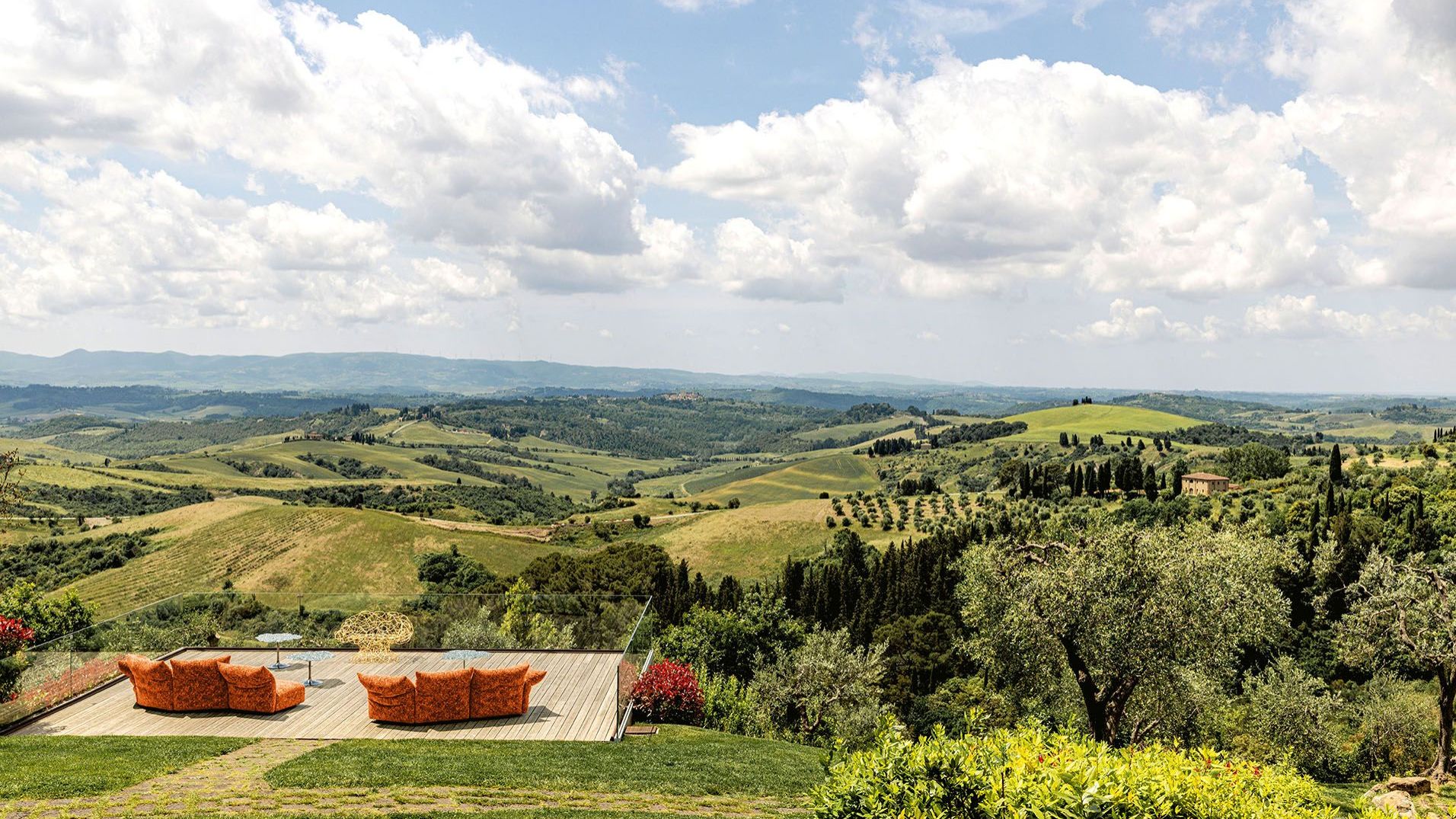
Following its acquisition by the Lohia family, who took over the property in 2021 and began a complete renovation, Castelfalfi today houses a five-star resort that has returned the estate to its original splendour. This was more a gesture of love than an investment: “When Sri Prakash Lohia visited the estate for the first time, he fell in love with the scent of the earth” recalls CEO Mounir Husseini. The starting point for redesigning the spaces was careful listening, capable of finding a way to inhabit history with vision and respect. “Each element has been carefully chosen to create the right atmosphere. Every gesture here is measured, every presence necessary” says Mounir Husseini. In these spaces, furnishings by Edra move with the grace of the ideal guest, starting in the lobby, where a sense of quiet conviviality can be breathed. The On the Rocks sofa, with its mobile forms, is an island where time stands still, the soft comfort of Standalto an invitation to relax. But it is the spiral outlines of two iconic Tatlin sofas that catch the eye above all. Covered in specially commissioned green and beige velvets, they reflect the colours of a landscape that stretches out beyond the windows, magnetically attracting the gaze to infinity. “Each of the pieces introduced at Castelfalfi was born of a deep dialogue with the soul of this place” explains Monica Mazzei, vice president of Edra. “In effect our headquarters are not far away. We share the same horizons, the same sunsets, the same ideas of timeless beauty.” Adjacent to the seats, Cicladi tables create an archipelago of Volterra alabaster, their apparently spontaneous organic forms designed with meticulous care: truly functional sculptures, they reflect nature's harmonious irregularity. The Ines lamp, cast by hand in polycarbonate, is an ode to lightness, sitting precisely among the spaces, it illuminates with a vibrant golden light, warm as the sunset on a field of wheat. Like the other elements, it was chosen to draw out the local essence, never to overpower it. "We simply followed the rhythm of the place" admits Mounir Husseini. And we can feel this.All around, the estate is a world unto itself. The 1,100 hectares of nature include woods, vineyards, lakes and trails as well as one of Italy's most scenic golf courses. The village has come back to life together with the resort. Guests and residents mingle in shops open on the main street and at the tables of the gelateria. There is a spa open to non-residents of the hotel, and a thousand trails to explore on foot, by bike or simply with the eyes, spying hares, deer and foxes. At sunset, colours become liquid and everything seems to shimmer in an ancient calm that diffuses everywhere. This is the charm of Castelfalfi: a rare union of nature, architecture and human gesture. Edra furnishings, placed throughout the common areas, embody a balance of tones and forms inspired by forest, earth and stone. They do not impose, but silently dialogue with light, materials, and people, so that every object becomes a tactile experience, each moment seated, an emotional pause. Nothing is here by chance, and in the end nothing is truly static. The Castelfalfi furnishings continuously change skin in a never-ending work in progress, adding new elements each time. The outdoor sofas Standard and Sherazade, take soft comfort into the open air, dressed in Every Stone in the colours of grape must and olive trees. The outdoor seats of the A'mare collection add glints of marine light, the armchairs, sun beds, benches and tables, fashioned by hand in recycled polycarbonate, sparkling like solidified water and reflecting the rosy sky of the Tuscan evening.
As night falls, the village lights up like a lantern. In summer, the murmur of conversation mixes with cricket song, clinking glasses and footsteps sounding on stone. In autumn, the estate is clothed in intense colour, forests turning red, burnt orange and copper. A perfume of earth and wood hangs in the air, and horizons are pictorial. “It’s like living in a canvas by Leonardo da Vinci” wrote one guest, and it is true. These panoramas are never simply a backdrop, but a story that is living, a poem of slow hills. A refuge for those who love a quieter beauty, for those who listen, touch and savour, for those seeking places where time, instead of running away, stops still. The objects, like those by Edra, chosen to accompany this awareness, are an invitation to stop, to look, to slow down. A caress on the landscape, they remind us of what it means to inhabit time.


