




September 2026
Teatro alla Scala Edra Evening of Honor
Dance and design: no longer separate languages, but complex devices in dialogue and exchange generating a single field of experience. This is the profound meaning of Edra Evening of Honour at the Teatro alla Scala in Milan on 23 April 2026, entrusted to the young talents of the Ballet School and the Orchestra of the Accademia Teatro alla Scala, under the musical direction of Maria Seletskaja. Reconfigured as a territory of resonances between bodies, objects and music, the stage of the prestigious Teatro alla Scala becomes a suspended space where a shared experience of concrete imagination unfolds. Design entered the choreographies performed by dancers of the Teatro alla Scala Academy, and choreographies gave objects an animated anthropized dimension.
The evening opens with Presentación, conceived by Olivieri himself, director of the Ballet Company of Teatro alla Scala and director of the School, based on Carl Czerny’s Étude. It is a visual atlas of growth, a progression displaying the entire arc of the dancers’ learning, from the initial immature gesture to the full mastery of body and steps. The piece can also be interpreted as a metaphor for the work of Edra. As in dance school, the knowledge of the company is constructed through a stratified daily practice. Starting with the essential grammar it arrives at a complexity maintaining precision. Each passage is necessary. Each detail contributes to the excellence made manifest when technique and vision come together.
The evening took on a more intimate resonance with a talk by Humberto Campana, his Italian marked with the echoes and accents of Brazilian musicality. The designer began with memories of the moment when everything that followed after might never have happened.
"Edra decided to produce Vermelha just as my brother Fernando and I were about to give up” he recalled, “No one seemed to believe in us. Then suddenly, someone understood our vision". The words condense a crucial passage to do with design and dance. The moment in which someone recognises the necessity of a new form. Which is what Edra does when it intercepts pathways, supports visions and makes the suspended possible.
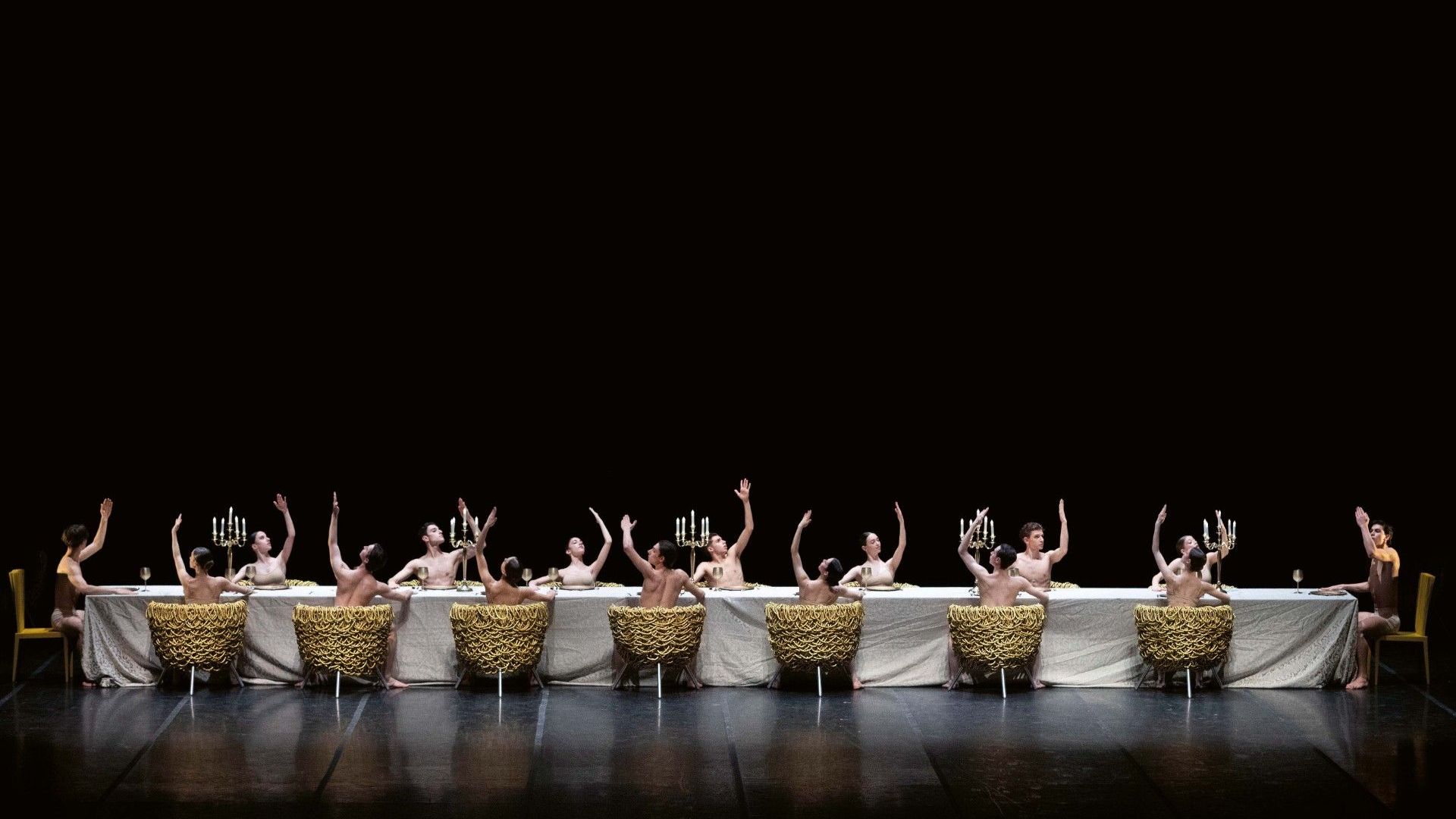
After emotionally remembering his brother Fernando, who passed away in November 2022, Humberto left the stage, where music and dance broke out again. With Mauro Bigonzetti's Rossini Cards the language of dance opened to a more fluid dimension. A long table filling the entire stage became a choreographic device and a symbolic place of relations. Dancers moved in unison, building up a visual and musical rhythm, as Rossini’s score pressed with its insistent dynamic of precision and sudden accelerations. The Campana brothers’ Vermelha armchairs and Janette chairs created a relation with the dance, their textures introducing an organic tactile dimension, in dialogue with bodies and amplifying their presence. The choreography continued with the Péchés de vieillesse, an alternation of duets and solos etching out the space, before a final chorus in which Rossini’s crescendo was translated into a progressive sequence of energy. This relationship between music and body took on a constructive quality, developed in accumulations, tension, and release. A principle that also belongs to Edra's work, each project born of a balance between control with freedom.
The culmination of the evening was Shahar Binyamini’s Bolero X. Fifty dancers on stage with one pulse passing through their bodies, making them part of a larger organism. The Ravel theme expanded like a wave, from the minimal dimension of the initial flute to the full engagement of the orchestra. The quality of the relationship built between dancers was striking. No individuality predominated. Everything is founded on the constant negotiation of space, on a reciprocal listening that transforms multiplicity into unity. In this choral construction a proximity to Edra design can be recognised. Each piece is born of a weave of skills, hands and knowledge, that come together in deep harmony. The results take on shape as living systems in which each element exists in connection with the others.
The diverse arts meet, in a tension towards the future that retraces traditions and renews them. La Scala and Edra share the same idea of excellence: continuous process, openness to risk and a willingness to recognise the possibilities of forms to come.
In his greeting, Valerio Mazzei told us, "I have been working for exactly fifty years. Fashions, trends and strategies worked out at the drawing board are far removed from my world and from Edra. Nor do I allow myself be carried away by instinct. However perhaps this is an illusion, and it is precisely this instinct that guides me". In this oscillation, between control and letting go, we recognise another shared trait of dance and design. Works take shape in a process that, each time, is renewed. A practice requiring time, listening and trust. And which, in both cases, pursues a profound and enduring ideal of beauty.


