




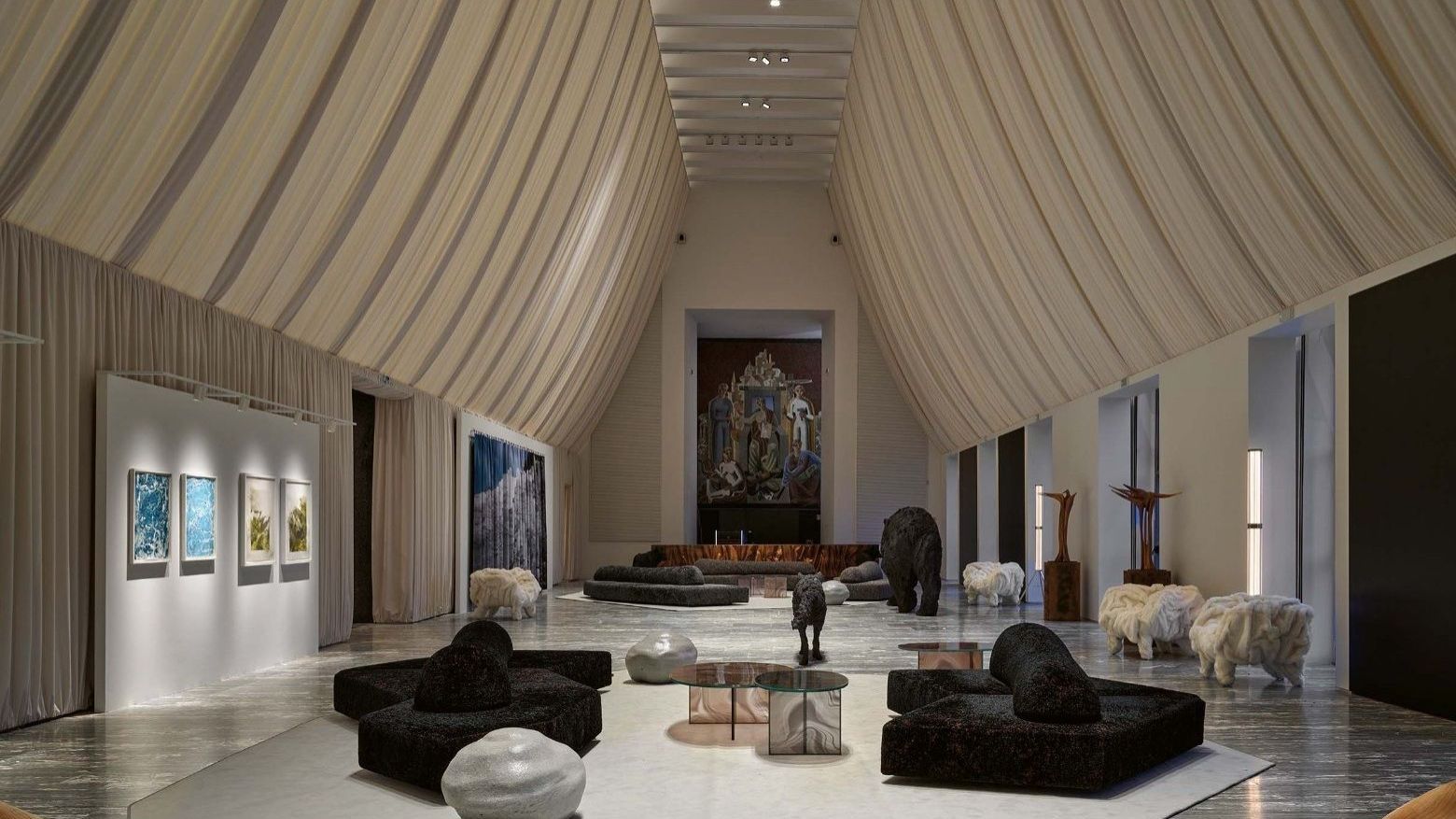
Casa Italia, Milan Triennale. The Hall of Honour welcomes national and international guests in an atmosphere inspired by mountain landscapes.
сентября 2026
Casa Italia at Milan Cortina 2026
The diffused project of Hospitality House recounts Italy through the experiences of inhabiting of welcoming and of relationships
Event is not the most well-loved word at Edra. Perhaps because it is a term that over the years has been increasingly consumed, until it describes, without distinction, inaugurations, presentations, launches and social gatherings. And yet, in its deepest sense, an event is not something that simply takes place. It is something that leaves a trace. It does not coincide exactly with the fact itself, but with its capacity for generating relations, experiences, and memory.
The 2026 edition of the XXV Olympic Winter Games in Milan-Cortina can be interpreted from this perspective. For the occasion, the Olympics, one of the most absolutely compelling spectacles on a global level, took on special significance, being held in our country. The edition marked a return to Italy after an absence of twenty years, and for the first time with a new intensity, related to its diffused presence, capable of activating different realities, landscapes and places,
An intensity that manifested in various forms, in different times, spaces and scales. It ran across the territory, in the familiar landscapes read in a new light and connected one to the other. It could be sensed in the athletic gesture, when audiences held their breath and bodies were stretched to the limit, becoming pure trajectory in space. Then, as suddenly, it melted away: when athletes exited the scene, left the field and entered a space lit up with a new energy, born of the encounter between different arts and disciplines. Casa Italia, the beating heart of the Milan Cortina 2026 Olympics.
Founded in 1984 as the Hospitality House of the Italian Team, and designed at the wishes of the Italian National Olympic Committee to welcome national and international athletes and guests, Casa Italia became a truly cultural device in 2016, capable of telling the story of Italian excellence not only through sport, but bringing in design, art, food and more. A system of cultural, artistic and human excellence.
This vision—which transformed Casa Italia into a sort of temporary cultural embassy—involved Edra from the beginning: from Rio de Janeiro 2016, through Pyeongchang 2018, Tokyo 2020 and Paris 2024, to Milano Cortina 2026. As Silvana Annicchiarico underlines, "In a world that is so apparently distant from design, Edra immediately understood that sport has a very closely tie with inhabiting, because both these two spheres reflect on the relationship of the body to space. While sport measures the action of a body in motion, effort and performance, inhabiting welcomes it when it is static and at rest. Becoming part of Casa Italia, Edra ignited a spark, a light, this wonderful short-circuit between sport and furnishings".
The image is precise: a tension not cancelled, but transformed.
At Milano Cortina 2026 the theme of relations involved people, but above all, places. For this edition of the Games, Casa Italia was configured as an articulated system of spaces between Milan, Cortina d'Ampezzo and Livigno, constructing a geography of Italian landscapes, rhythms and atmospheres. The three locations functioned as variations on a single experience. "Not three distinct homes," explains Lorenzo Pellicelli, Marketing Director of CONI, "but a single home with three different perspectives." Milan represented the centre of this story: a place for discussion, panels and meetings with partners and stakeholders. Here Casa Italia took on a more explicitly cultural and institutional dimension. Cortina embodied excellence in hospitality: a more intimate space, directly connected with the Alpine landscape, where the theme of hospitality was expressed in its most immediate form. Livigno introduced a different energy, youthful and dynamic: a more open and participatory part where sport met with fans, a place where experience became informal and shared. The three locations responded to three ways of living the same event: representation, welcome, participation.
Connecting these three locations was Musa, the concept of Casa Italia 2026. Every year, the choice of theme has followed a principle of showcasing, but above all of narrative. Beatrice Bertini, Casa Italia curator says, "This time the project was born of a desire to turn the point of view around: not directly affirming Italian identity but letting it emerge through the gaze of others". The exhibition Musa, hosted at Milan’s Triennale and partly in Cortina, brought together works by international artists who have found inspiration in Italy. "This is not us saying we are an extraordinary country," she suggests, "we let those who have looked to Italy as a muse for centuries, tell the story." This reference to the Grand Tour has acquired a precise meaning: Italy as a place to travel through, and of inspiration. In this sense, Musa was a broader reflection on what holds different languages, disciplines, and sensibilities together, using a structure as cultured as it is evocative. The itinerary was divided into nine sections, each one dedicated to a muse of classical tradition, from Calliope for words to Clio for history and architecture, Erato for the love song and Euterpe for music. This system of symbols was used as a key in understanding Italy's capacity for generating imaginaries, knowledge, research and innovation through different forms of culture. In this reading, the juxtaposition of art and sport seems natural. "What artists and athletes have in common" explains Bertini, "is first and foremost a shared tension in researching the gestures made in order to go further, pushing towards forms of excellence. It is a dynamic related to sport but also to art, design, and project. It is not simply the final product that counts, but the process of research, the constant challenge, that leads to redefining possibilities and languages". It is in this sense that Pierre de Coubertin imagined the profound affinity between the practice of sport and the practice of art: both initiated by the same impetus, by the same attitude of experimentation and transformation.
In this diffused system, the project for Casa Italia interiors played a decisive role in creating continuity between the three sites, while also maintaining differences. Architect Bianca Patroni Griffi, who curated the interior design, explains, "The starting point was the search for an image capable of holding the story together: mountains. Not only as landscape, but as atmosphere. On the one hand, concrete mountains—made of rocks, wood, mineral surfaces, reflections and light—and on the other, the more domestic and enveloping interiors, warm, welcoming and almost protective". Following this dual reading, the project was iterated in different ways in the three locations. In Milan, at the Triennale, the landscape was interpreted in a more abstract contemporary form: the furnishings constructed an evocative geography in which sofas and surfaces were reminders of rocks, marbles and strata. In Cortina, the narrative became more intimate: warm colours, natural materials, and tones evoking earth and wood, gave the idea of a cosy welcoming chalet. In Livigno, this same imaginary was reinterpreted in a freer, more dynamic way, with references to the 1960s and 1970s and a more playful component, in keeping with the youthful, participatory nature of the venue.
Edra furnishings contributed to defining the very meaning of these spaces. They were chosen for their ability to activate a sensitive relationship with those coming into contact with them. Not just objects to be used, but elements capable of suggesting and building a landscape. The project found coherence in this direction: the possibilities of correspondence between material and story. The jagged forms of the sofas, tactile surfaces, brilliant fabrics and reflective materials, made the furnishings an integral part of the experience. The made them part of the project, not only to carry out a function, but as if they were ideas capable of conversing with intellect and senses, becoming an essential component of the Casa Italia landscape.
One distinctive element ran through each site, like a common thread: the Grinza White armchair by the Campana Brothers. Dedicated to Milano Cortina 2026, a special version of this historic armchair in soft, fluffy white fake fur, interpreted snow not only as an image but as a condition, conveying the blanketed, suspended sensation where sounds are muted and time seems to slow down.
Over the years, Casa Italia has transformed: from a space of official representation to cultural platform, from single place to diffused system. An intense journey, whose complexity was the result of a process, in which Edra became a part, going beyond a simple collaboration for the design. Lorenzo Pellicelli explains it well: “This is a relationship that has been constructed over time, founded on a shared vision. Since 2016 the aim of Casa Italia has been to recount Italy beyond sport, to create a relation with all of its excellences. Here Edra found a natural space, contributing to a definition of the aesthetics of the spaces, but also to expressing deep values. The furnishings did not merely accompany the project, they became an integral part of it, entering into the lived experience of these spaces. Certain elements have become recognisable over time, almost familiar to the athletes. For them Casa Italia is a point of arrival. It is the moment they feel they are at home”. Casa Italia was not only a constructed space, but a space that was lived in: a place where experiences sedimented, transforming into memory.


